SOUNDTRACK
Favela
Written by: Marcelo Falcão e Xandão
Performed by: Vinícius D’Black
When we wrote the script, it was already our idea to select well-known songs, that could be easily identified by the spectator and that had some connection with the film. “Favela” was one of the first to be chosen. And from the beginning we thought of it for the opening scene. When we decided to make a long opening scene that represented the favela being taken over by the dance group, we had to adapt the song in order to support 7 minutes of varied situations. It was Fernando Moura and Marcos Susano who delivered the brilliant reinterpretation, based on the opening situations and dialogs.
Injeção
Written by: Deize Tigrona
Performed by: Deize Tigrona
The funk ball was very important to the film. This was where the couple would meet for the first time. We wanted someone strong and well-known, and at the same time we thought it interesting to choose one of the women who renewed the funk scene. Hence the choice of Deize Tigrona with her track Injeção (Injection). The difficulty was the musical transition from this scene to the next, where they meet. This too was solved by Fernando.
Você
Written by: Tim Maia
Performed by: Vinínius D’Black
In fact, this song was part of a duet that was to be sung by the couple after the ball, when they met for the first time. The duet, which was created by Felipe Abreu, vocal coach, whose input was decisive in all the singing material (choice of people, rehearsals, etc) initially consisted of several songs. During editing we thought it slowed the film down too much so we decided to leave just the beginning as if it were a fantasy of Analídia’s.
Você para mim
Written by: Fernanda Abreu
Performed by: Cristina Lago
Was also part of the duet.
Cantiga
Written by: poema “Cantiga”, de Manuel Bandeira
Performed by: Pedro Luis
I heard this song, which is a poem by Manoel Bandeira with music, when I went to a Pedro Luis show with Roberta Sá, in which they sang Cantiga. I immediately thought of using it on the beach scene. It would be a good transition from the favela to the world of the middle class. The expectation was then dashed by the idyllic view of Rio.
Pista de ferro
Written by: Kako do Hip Hop
Producer: Rodrigo Forli
Performed by: Kako do Hip Hop (Banda Via Perimetral)
Another composition of Kako’s, chosen as the background music for Dudu’s group’s barbecue. We needed something to play on the radio, that had a reference to samba, and he brought us this song.
“Corus” (six interventions)
Written by: Leroy Paiva, MS Bom, Nego Jeff
Performed by: Nação Maré
The Nação Maré group has been in the film since we started the screenplay. I thought of them after seeing the film “Vinicius”, where they reenacted a poem. That was in 2005. Right then, I had the idea of transforming the Greek chorus, as used in Shakespeare, to intervene and tell the story, into a rap group. I suggested to the group that they create raps that could be used in the screenplay. I gave them the script to work on and after several meetings, they produced the poems we used in the film. As the script changed, so did the raps. We only shot the raps after the film was cut. The rap background, created by Gringo Cardia and his team, also changed a lot in this period. The result only gelled after the film was cut. As for the arrangements, Fernando Moura and Marcos Suzano did an excellent job, and so that we could show the mixture present in the film, Fernando suggested that instead of the base used in rap groups, we use a louder musical score with more instruments, and other references.
Romeo and Juliet
Written by: Sergei Prokofiev
The dialog between popular and erudite music was present since the early days of the script, seeing as the film was an adaptation (albeit very free) of Romeo and Juliet. The reference to the world of classical ballet through the dance teacher was also there. That the choice fell on Prokofief (and not Berlioz, for example, who also has his Romeo and Juliet) was due to us wanting someone contemporary who carried all the drama that the scenes needed rather than a romantic option (which would be Berlioz). From this choice, used for rehearsing ballet and solos, it was extended to other dramatic moments of the film during editing, and made the theatrical connection we needed between these worlds.
Gente de lá
Author: Marcelo Yuka
Performed by: Cristina Lage, Vinícius D’Black e Marisa Orth
Corus: Juliana Ferreira, Ingrid dos Santos, Henrique Marques, Alessandro Portugal, Raquel Nascimento, Amanda Corrêa
Another Yuka song. But this song has already entered the second treatment of the script. It was a suggestion by Paulo Lins, co-writer, who brought me the CD Furto saying that it had a lot to do with the film. During the dance rehearsals, we dismembered the music, with the help of vocal preparer Felipe Abreu, and reassembled making the dancers participate more actively and incorporating the lyrics into the dramaturgy. Finally, the dramatic weight given by Fernando Moura in the final arrangement, taking the music also to the war scenes that interrupt the dance, created a climate that ended up showing “musically”, without words, this tragedy of young people lost in the midst of violence.
O mundo já se acabou
Written by: Walter Alfaiate
Performed by: Flávio Bauraqui e Vinícius D’Black
Published by: EMI
Queríamos um samba, que seria a opção do irmão mais velho. Pensávamos num pagode “mais moderno” que falasse em trabalho. Mas, pelo contraste da cena entre a violência policial e o pagode, acabamos optando por este belo samba de Walter Alfaiate que fala de irmãos e da surpresa do que acontece com o mundo. Uma curiosidade: Walter iria participar da filmagem, mas no dia teve um problema e foi hospitalizado.We wanted a samba, as the option for the older brother. We thought of a more modern “pagode” that talked about work, but with the contrast of the scene between the police violence and the “pagode”, we decided on this lovely Walter Alfaiate samba that tells of brothers and the surprise at what happens in the world. Incidentally, Walter was going to be involved in the filming, but on the day fell ill and had to go to hospital.
Som de preto
Written by: Amilcka, Chocolate, DJ Marlboro
Performed by: Cristina Lago e Vinícius D’Black
Corus: conjunto de bailarinos
This is a typical (and ironic) story of a globalized world. I heard this “war cry” of the funk movement for the first time in Paris, at the end of the Brazilian Festival of Paris during the DJ Marlboro set. Right then I had the idea of letting the dancers sing this freely as an affirmation of their identity.
O Racha
Written by: Kaku do Hip Hop
Produced by: Produced by: Rodrigo Furli
Performed by: Kaku do Hip Hop and Vinicius D'Black
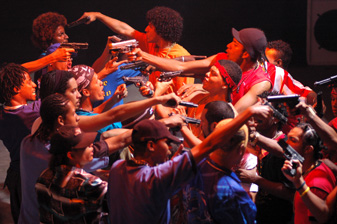
Kako (Amaury to his friends) was selected for the dance group during our first auditions. Later, when we were deciding who could sing on screen, he told us he was a composer . One day during rehearsals, he brought me this piece as a suggestion for the hip hop battle that was in the script. It ended up as one of the film’s high points.
Aê meu primo
Written by: Pedro Luis e Pedro Rocha
Performed by: Marisa Orth
Chorus: Juliana Ferreira, Ingrid dos Santos, Henrique Marques, Alessandro Portugal, Raquel Nascimento, Amanda Corrêa
Again, a song that was in from the beginning. I wanted something critical but upbeat for the group to dance to at a moment when the violence between the factions – and its repercussion within the community– had not yet escalated. Preparation of the chorus and the division of the lyrics among the various groups, keeping Fernanda (Marisa Orth) as leader of the game was done by vocal coach Felipe Abreu.
Minha alma
Written by: Marcelo Yuka
Performed by: Vinícius D’Black e Cristina Lago
Chorus: Juliana Pereira, Ingrid dos Santos, Henrique Marques, Alessandro Portugal, Raquel Nascimento, Amanda Corrêa
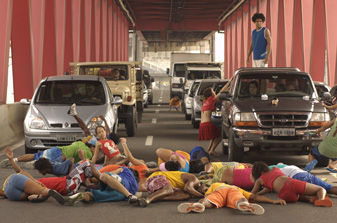
This was also decided for in the first draft of the screenplay. And from the start it would be performed in the Linha Vermelha Expressway scene, to show the middle-class how much it too is made prisoner by choosing the railings of separation. Maybe because Marcelo Yuka is so viscerally connected to the reality we are dealing with, we ended up choosing more than one of his tracks. The arrangements by Fernando and Marcos, based on the choreography and the material already cut, add even more value to the scene.