
Cristina Lago
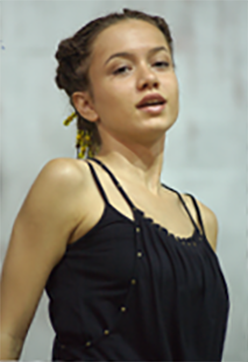
‘Another love story’ is Cristina Lago’s first film. She takes the part of Analídia, daughter of a jailed drug baron, who goes against the local order in the name of dance and love. Cristina was born in Foz do Iguaçu, Paraná, and brought up in a small town called Ouro Preto do Oeste, population 40,000, in the state of Rondônia. This kickstart to her career as an actress has already borne fruit. She has just been given a part in the next José Joffily feature film, ‘Olhos azuis’ (Blue Eyes), as a hooker who helps an American find his daughter in Brazil.
Living in Rio since the age of 19, when she came to study theater and dance, she graduated from the Angel Viana University in 2004, took part in the project “Ateliê Coreográfico” with Regina Miranda, and studied acting at Tablado, in the Laura Alvim Cultural Center and the Studio Actors’ School. Cristina also acted in theatrical plays such as ‘Nosferatus, um pouco de nós’ (2003), by Marcos Henrique Rego, and ‘O alfaiate do rei’ (2004), by Maria Clara Machado, directed by Cacá Mourthé, and Ariano’, (2007), by Gustavo Paso, an 80th birthday tribute to the writer Ariano Suassuna. Her dancing experience led her to choreograph the show ‘Geração Trianon’ (2005) by João Brandão for the Tablado, and solo in a Lúcia Murat musical, plus a pas de deux, together with D’Black (Jonathan), her partner in the film, both under the supervision of ballerina Áurea Hammerli.
INTERVIEW
How important was it to do ‘Another Love Story’?
I’m still evaluating, but it was enormously important. I was born in Foz do Iguaçu, in Paraná, but I grew up in a small town of 40,000 inhabitants, in Rondônia, called Ouro Preto do Oeste. I came to Rio to try an acting career and I know how difficult it is to get a job. Lúcia opened a wonderful door for me. I then lived through an intense process – I had never danced hip-hop, for example, which has very specific movements, so I had to learn. The head understands, but the body takes time to catch up. Apart from this, there was a lot of choreography and I hadn’t danced seriously for two years. I had to learn to speak and sing like a Carioca. It was intensive, but enriching and gratifying – the best school I’ve had up to now.
You got to choreograph some parts, under the supervision of Área Hammerli. How was that?
My specialty is contemporary dance, and as I know my body better I ended up choreographing two numbers for the film. One solo, which I do on a glass floor, an interesting device for filming, and a pas de deux, together with D’Black.
What was it like working with D’Black, and Marisa Orth...?
With D’Black the chemistry was good. We got on well together, building a partnership, a friendship, during rehearsals, which was very important and I hope shows up on the screen, after all that was the objective. Marisa gave me a lot of help. She worked us hard, and also Elisa Lucinda. The advantage of acting opposite experienced actors is that they demand more of you. And they weren’t intimidating, they were cool and always there for you.
Your experience on video was practically zero. What did you find most difficult?
Cristian Duuvoort (actor preparation) did a terrific job for us all. When I see myself on the screen I get a big surprise. To begin with it seemed so strange. You always think you can look better. The first few times I saw myself I got all emotional. Working on a set is much less glamorous than you imagine. You’re there crying, but all around are lots of people, cameras, make-up... and you have to maintain the emotion. Lots of times you film at night, very late, you get sleepy, tired, lazy, but you have to react and not let the energy diminish. Because when they shout ‘action’, you have to be wide awake. This is what an actor does, and believes in what he’s doing. In the José Joffily film I’ll have to speak English, and smoke. But that’s what I like – learning new things.