
Vinicius D'Black
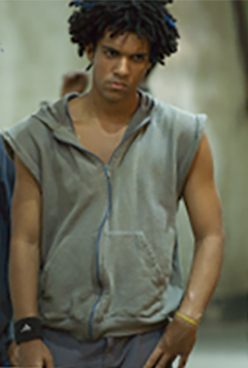
A singer, like his character Jonatha, he has wanted to make a CD since he was 15. A teacher of ballroom, jazz and tap dancing, Vinícius D’Black was chosen from among more than 500 boys who tested for the part of MC, brother to Dudu (Babu Santana) and Paulo (Flávio Bauraqui), who falls in love with the daughter of the opposing drug baron. Previously, only an independent career as a singer and some bit parts in TV and in the musical ‘Certas canções’, with the group ‘Nós da dança’, last year. In the film, D’Black sings ‘Minha Alma’ and ‘Gente de Lá’, by Marcelo Yuka, ‘Pneu Queimado’, by F.U.R.T.O., ‘Você’, by Tim Maia, and ‘Favela’, by Marcelo Falcão and Xandão. Living in the Rio das Pedras community, D’Black has no problem identifying with the character he plays in the film.
INTERVIEW
What has Vinícius D’Black in common with Jonatha?
I was born in Freguesia, and lived as a child in Pedra de Guaratiba, which is a rural area, and at five I moved to Gardênia Azul. Today, I live in Rio das Pedras. I like to say that in Brazil the greatest art of all is to survive on art. I think that Lúcia saw in me this person who lives on a dream. I’ve been on the road since I was 15, fighting for survival, so I was very, but very happy to do this film.
Was it difficult to act?
Very. I had no idea what it was all about. Lucia covered for me, but she had confidence in me. Júlia Murat (1st Assistant Director) helped me a lot. Babu Santana helped me too, and Flávio (Bauraqui). Babu once rehearsed three days with me alone. In the end the scene was okay, but as we left he said: ‘we found our scene, tomorrow we’ll have to find Lucia’s’. Lucia pruned the scene till it was the size she wanted. The important thing on the set was to not crystallize, but to take advantage of the chemistry of the moment. Fabrício (Tadeu), on steady cam, also helped. He would say look over here, look over there. The first day of filming was terrible. Julia made me run up and down some steps in the ‘favela’. She knew the scene she wanted, but had no idea how it would come out. She wanted me to get tired, and when it came to filming she wanted me to appear as if I had always used those steps. They gave me a heavy back-pack, and warm clothes – to look like the real thing. In the first take, Lúcio (Pereira), long hair, one of the gang, hung on a wall to jump on me, and the wall nearly collapsed. Then later my back-pack got stuck on a railing. Much later I learned to improvise a bit when these things happened. Once my shoe fell off and I just kicked it hard, making my anger more realistic.
Which were the most difficult scenes?
The heavy, dramatic scenes were the most difficult. You had to show emotion from one moment to the next. At the beginning I would arrive on the set feeling so afraid, so scared that I didn’t enjoy it. Then as time went on I began to feel better, but to begin with everything was very difficult.
And how was the dancing?
I felt like the ugly duckling when I had to dance, because the others were so good. But everyone was very helpful and I started to learn – though dancing was easier for me as I had been a dance teacher.
And the singing?
This was the best part. I sing ‘Minha Alma’ and ‘Gente de Lá’, by Marcelo Yuka, ‘Pneu Queimado’, by F.U.R.T.O., ‘Você’, by Tim Maia... But it was ‘Favela’, by Marcelo Falcão and Xandão, that opens the film, that I liked best. I had taken lessons with Felipe Abreu for voice training and singing and it was great to work with him again. I always think how many people would like to have made this film, and I did it. I had taken part in ‘Pop Star’ and ‘Fama’ on TV, but nothing to compare with this film. It’s a dream come true.