|
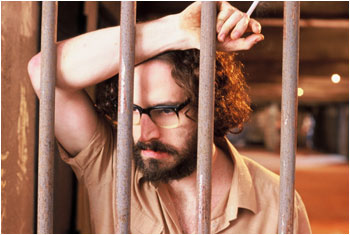
An experienced movie actor who has played in more than 12 films, in addition to television and theater, Caco Ciocler performs the role of Miguel, a middle class guy in the eye of the storm of the military dictatorship in the 70s. Leading the political prisoners at Ilha Grande Penitentiary, Miguel manages to improve living conditions in the prison through a hunger strike. After having had an excellent relationship with the regular convicts, highlighted by his friendship with Jorginho(Flavio Bauraqui), he finds himself in the center of a conflict that starts when more regular convicts are put in the cell. At this moment various questions raised by the political prisoners are put in check, like his friendship with Jorginho.
How did you construct Miguel, your character in “Almost Brothers”?
The job of a movie actor accompanies the filming, you build it on the set. If the actor is too rigid in what he thought about his part beforehand, he will suffer needlessly. I think the most interesting thing about working in the cinema is that a movie is a puzzle: nothing is shot in chronological order. So the shades of feeling you give your character in a specific scene, will determine his trajectory in the rest of the film. This process is very stimulating.
This project with Lúcia Murat was very demanding for the actor in me. It was a joint effort in every scene. For her, the script is merely a rough guide, and because of this, I was impressed with how the scenes transformed themselves in a very organic way. Lúcia didn’t have a film ready in her head. She didn’t simply ask the cast to act out a story she had in her head. The direction was very open at all times, and in this sense it was an interesting construction of the group of characters. .
How would you describe Miguel?
I was only responsible for one third of this character. There are two other actors responsible for this life. I made an effort to give Miguel both chronological and character growth. He starts out as a radical guy, stubborn and secure in his ideas. After two tears in prison he still has his ideals, but I guess they are more mature, perhaps a bit more tired. What most intrigues me about this story is the fact that someone dedicated a large part of his life to a cause, and this cause had finished.
This film has a special improvisational quality. When this happens and the creative part is shared with the actors, it’s a little scary. Lúcia’s trump card was understanding that the film would only happen if the creative part loosened up. .
I can say that I have never felt so responsible for a film , like a co-author. I really felt ownership of the film. I find Lúcia very democratic, always open to any kind of interference, suggestion, comments, criticism. For me this was the coolest thing about “Almost Brothers”: I felt very responsible for it.
What is your perception of the epoch that your character lives in the film?
The film speaks of an epoch that has always excited my interest. In 1970 I was being born, my family had no direct contact with this story. I never heard anything about this story at home. Then, when I started to hear about all this, the thing that fascinated me the most was that people had dedicated their lives to a cause and then, suddenly, this world dream died. How was it for these people to see this dream die I thought strange, this dream didn’t die, but did he think it did? This is until the part where Werner Schuneman assumes the role. That‘s what really intrigued me the most, how these people managed to conform and re-adapt to a society so completely adverse and contrary to all the things they had fought for for so many years.
I think the movie also has social function: tell the story to people other than those who have lived it, tell it to the new generations. Explain that there was a group who believed and saw in themselves the responsibility to change this country. This film tells us a little bit about the story of Brazil and raises a question that is increasingly harder to deal with which is violence. “Almost Brothers” speaks about the social gap that we have created and whose frightening results we are only now seeing. The film addresses this division, this divergency, which we are paying such a high price for today. I think that, aside from everything else, this film is very important for the times in which we live today.
What struck you the most, in the character and in the film? O que fica de mais forte, para você, desse personagem e do trabalho no filme?
Lúcia lent me a film that she had made about ex-convicts and my intuition about the feelings of political prisoners was confirmed: how it was tough, all the torture, something almost unimaginable to my generation. I guess on account of this I was so taken by her democratic behavior on the set. It is a universe so much her own, because she has lived through all of it, and that made our task a difficult exercise. It was beautiful to see this in Lúcia.
As an actor, it was also an honor to work with the actors from “We of the Hill”. They have an impressive ability to improvise .It was a lesson. Sometimes Lúcia let a take roll and depend on them, this take didn’t have an end. This was very important for me, Acting with Flavio Bauraqui was also great. I had to have a strong complicity with Flavio, I remember that one day of our rehearsals we went out for tea and had a beautiful conversation. Flavio told me a little about his story and I told him a little about mine. It was very moving and I guess we were able to bring some of this feeling to the film. He is an actor I have admired since “Madam Satan”. This film was a happy encounter in all aspects. Jacob’s camerawork is also very enjoyable for the actors as it is loose and puts them very much at ease in scene. I get the feeling of having made a great film. A film with a lot of love and dedication on everyone’s part. And more: telling a beautiful story. I thought the script first class, speaking about a time most people don’t have access to. Playing this role made me think about history with another mindset. I think when you learn things in school, you are an adolescent, worried about other things. To be able to go back to Brazilian history with another perspective, as I have been able to do now, and re-study the whole process, is very rewarding. .
|