
Gringo Cardia > Production design
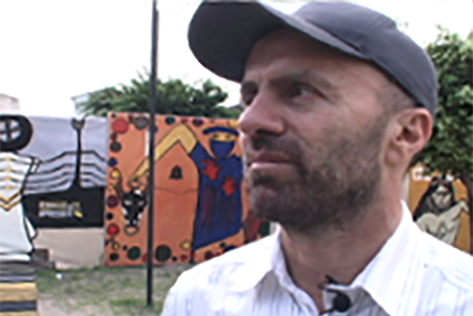
More than 50 video clips to his credit as director, both musical and institutional, scenographer for more than 100 theatrical productions for directors such as José Celso Martinez Correa, Antonio Abujamra, Amir Haddad, Bia Lessa and Hamilton Vaz Pereira, designer for H. Stern in New York, among others, creator of graphic designs and show director for artists such as Maria Bethânia, Marisa Monte, Rita Lee, Daniela Mercury, Gilberto Gil, Marcelo D2, Carlinhos Brown, Tom Jobim, Lulu Santos, Skank, Marina Lima and Chico Buarque. Having created the sets for the film ‘As cidades’, Gringo Cárdia, artist and architect, accepted the job with Lúcia Murat’s ‘Another Love Story’, for the sake of the certain magic of a musical and the proximity to the universe of the city periphery.
One of his main exhibitions - ‘’Estética da Periféria’’ (The Esthetics of the Periphery), shown in Rio de Janeiro, Recife and São Paulo, inspired his art direction for Lucia Murat’s film. Winner of various awards - Shell, Tim, APCA – Associação Paulista dos Críticos de Teatro, Festival de Cinema de Brasília, Sharp, APETESP, VMB Brasil, VMB USA 1990, he was nominated as the Personality of the Year for the “Making a difference” award given by the O Globo newspaper in the sector Education and the Young in 2005, for his work with his schools Spectaculu and Oi Kabum!, in Rio de Janeiro.
INTERVIEW
Your last major work for the cinema was in 1990 (in “Não posso falar sobre isso agora” (I can’t speak about this now), by Mauro Farias), why is it that an artist so active in the theater, in shows, does so little with cinema?
I work very little for the cinema, because most of the time it is very realist. However a musical in a favela gives one room to create on top of what already exists, with a certain poetic license. What I did was to put into focus things that in normal filming would pass unperceived. The general concept of art direction followed the urban pop culture of the favela. A culture of reinvention of language. A reinvented daily routine. This imaginary reality, which is in the mind of each person and which appears in the way they express themselves, has many subtleties. The explosion of colors, surprising in their harmony, is a view of the periphery, of a place where there are no limits. The periphery is poor, but suffers from excesses. All Brazil is like this. In a universe of difficulties and poverty everyone wants to reinvent their world. So you have a green house with a purple window on one side and pink on the other, and further on there is a yellow one. And so they go on building a notion of a group, of beauty. These people are authentic within the limits of their dreams. There’s no fashion, because there’s no money to follow fashion. So this reinvention is a lesson to all of us as to how, considering their hardships, they manage to construct a universe, equating their desires with what’s possible.
Much of your work reflects these esthetics of the periphery...
For a long time my work has involved the periphery. I have always had an interest in social projects. True Brazilian culture is in the periphery of the city and in popular art. I like the contemporary esthetics which we find in these so-called underworlds. Lucia had seen my exhibition ‘Estética da Periferia’, in the Post Office Cultural Center, in Rio, where I tried to show this universe of architecture, design, fashion, visual communication – as products of the periphery, highlighting the excellence that is achieved so informally. A favela has plenty of collage, painting on the walls, graffiti... What I did was to bring this to the film, without being documental. A cleaner favela, without pasteurizing, creating an interesting artistic concept. We even painted a few houses, but in the end we couldn’t tell the difference, like the writing we did on the walls. Lucia would look and ask us if we had written that or was it there before? The film, without removing the real, shows the hiper-real - which already exists - in a more objective way.
How did you get the idea for that collage that moves with the chorus?
Lúcia wanted a chorus, telling the story, as in traditional tragedy. As it was a pop musical, she wanted the chorus to stand out as different to the normal scenes. One option was to do this in 3D. We would film and then use computer graphics to make the scenery dissolve. Like something parallel to the scene – almost a videogame. This brought a contemporary touch to the film.
How was the relationship of art direction with filming and costumes?
The job of the art director is to ease the work of lighting, set design and wardrobe. The dialog is common to all. We needed to identify the drug gangs, for example. We did this with colors as they do in real life. We created two universes, one cool and the other hotter. This idea went to the costume designer and couldn’t be in bits and pieces, it had to be big. In the favela people dress like that. Living on the edge of society, they like to show their faces. The technique is based on the result you want. It was the first time I worked with Kodato (Director of Photography). He is very talented, professional and technical. We discussed the lighting for the Funk Ball, the color saturation... This team work was essential.