
GRACIELA FIGUEIROA > COREOGRAPHER
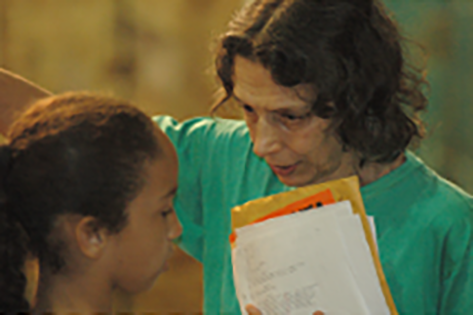
Graciela Figueroa, born in Uruguay, is one of the most important names in choreography and Brazilian contemporary dance. Responsible for disseminating theater-dance in the country at the end of the 70s, and creator of the group 'Coringa', which produced names such as Deborah Colker, she created the choreography for ‘Another Love Story’, her first musical in Brazil. One of the first to direct the 'Intrépida Trupe' and to choreograph pieces for groups such as 'Asdrúbal Trouxe o Trombone', Graciela returned 14 years later to direct a group of dancers made up of youngsters from poor communities, adepts in the hip-hop movement and groups such as 'Dançando para Não Dançar', 'Cia Urbana de Dança', 'Cia Étnica' and 'Grupo Independente Street de Caxias'. A student of the Martha Graham School, Juilliard School and Merce Cunningham School and member of the Lucas Hoving and Twyla Tharp dance companies, Graciela once again faced the challenge of finding for Lúcia Murat’s film a scenic presence among the cultural diversity that permeates dance and music in Brazil.
INTERVIEW
Where does dance stand in your life?
Dance is the breath of life. It’s a need. It is part of the central core of my life. Since a child I felt the need to dance. Today, my whole life is dance. I achieved a different level when I did something artistic. In everyday life, I was an ugly duckling. I therefore attempted to fill my life with dance.
What is new about this project?
As a choreographer, I have worked with many different groups, but this is the first time I’m working with a large contingent of people who do street dancing. And this dancing is totally vital for them. Like it was the movement of their lives. Not long ago I was working with classical ballet in Montevideo. The other extreme, let’s say....
Is it more difficult?
It’s difficult to create a new vocabulary for this. I also learn with them, because in classical dance the symbology is already more or less defined. To just dance would be easier, because my body senses the movement, but as choreographer I have to work so that they can dance.
Will the film include a wide range of movements?
I have never worked with a style such as hip-hop, for example, which is re-codified and full of subtleties and expressions. I have always worked with empty spaces, looking for something to appear at the time, changing what I was building, the techniques. But their love of hip-hop is like the fountain of life. They have a generous nature, and were always teaching each other the steps - learning one from another. They were intensely dedicated, and it was lovely to see them searching for the language. But I also knew that they could do something different. This is my idea of choreography and of life. It’s an attractive theme.
What language is this?
It is a strong and striking language, with a high dose of adrenalin. It’s so strong that it is difficult to hear other notes – like a very distinct instrument. New stuff like foot movements, in other rhythms, are more difficult for them. The objective was to make their art express itself in a language common to all in the film but like nothing we had before.
And what common expression was found?
Lúcia wanted a language of great impact. I had little time to build it. She would come to rehearsals, bringing the drama she wanted to imprint on the dances. This was another commitment and I had to study the whole concept of the film, always taking inspiration from current, contemporary movement. For this I needed to know what was happening with dance here – understand this other energy.
How did you create choreography for dancing in a favela?
The universes were very simple, routine, like running, touching... the material also, like beach, the Linha Vermelha expressway, where everything was built on what they already had. The music was very strong. I would throw things together and then tie them up. This worked well with eager youngsters and the pyramid started to grow. Sônia Destri was dedicated to the work and added to the ideas, rehearsing. And when they got on location, the references were strong, with the wealth of alleyways, slopes, stairways..., all this helped with the movements, making them cleaner – till they got to the point of total interaction with the scenery. It was as if the scenes, the environment with all its vibrations, and the spaces were literally dancing along with them.