
EMMANUEL CROSSET > MIXING ENGENEER
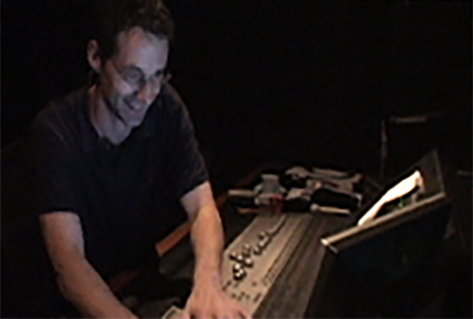
At the 2007 Cannes film festival, Emmanuel Croset had the pleasure of seeing four films mixed by him selected (one in each part of the festival). This was one of the great moments in the life of this French mixing engineer, who has also had good experiences with Latin American films. His first film was the award winning “la Cienega”. Later he worked with Lucia Murat in “Quase Dois Irmãos” and now he is in Brazil to do the mixing for “Another Love Story”.
INTERVIEW
How was it working in this film?
For me it was incredible work. I had never worked with music so beautiful, so well mixed, so well composed. I had never worked in a film in which the sound was so important for the film and of course for the audience. When we finished “Quase Dois Irmãos”, I told Lucia that we had almost made a musical. This time, when we finished, I joked with her that we had almost made an opera!
How was it working in a film that has moments of reality and moments of fantasy?
On studying the direct sound (dialogs) and the voices singing the songs, what I tried to do was to create a sound in which everything came together, in other words in which the speaking voices were similar to the singing voices – on the same level. For this I used a lot of reverb in the voices, so that the dialogs sounded more “musical”, which allowed a less brutal transition from dialog to music, less strange for the audience.
Especially on the Linha Vermelha Expressway, how did you work it so that the audience could enter the world of fantasy without finding it strange compared to the real world?
Ever since I saw the DVD of the film that Lucia sent me with just the direct sound and the voices, I could see that the idea would go over well due to the way it was filmed. This meant that my work was to accentuate this and in any case, as the film starts with a song (the opening), I reckon the audience would not find this so strange.
Is it normal during mixing for you to remove the sound of a particular sequence?
Yes, the mixing is when all the sounds come together and we can make a choice. There are things that only come in during mixing, which is when you have the whole film, with all the scenes, sound effects, direct sound and music. The decisions are taken little by little. Whereas in the editing one finds the rhythm of the film, I think that in the mixing one really finds the sound of the film.
What was the difference between working on “Quase Dois Irmaos”and here? And how is it working in a foreign language?
Working in another language – well, you always need someone near who knows the language well – but on the other hand I have the impression that I feel the music of the language, which makes the work very interesting.
As for the first question, when I worked on Lucia’s film in Paris, I wasn’t lost, it was my city, but in the universe of sound, I was completely lost. It was all very new. Here, on the contrary, I am lost in the city, I’m a foreigner, I don’t have the codes, but the sound is this country’s sound, and I’m here. It is less complicated.
What was the concept you had for the mixing?
I think we had a concept, yes, the concept of freedom. We didn’t ask ourselves if this had been done before or why people were dancing in the favela. Everything was possible. And this concept – of true freedom – was very important.