
LÚCIO KODATO > CINEMATOGRAPHER
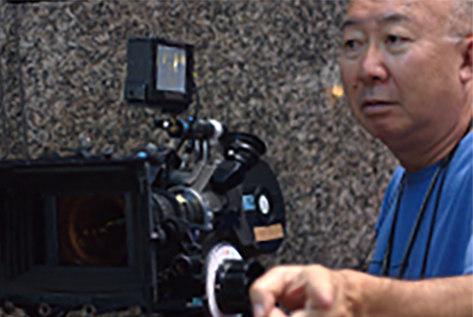
‘Another Love Story’ is Lúcio Kodato’s first job with Lúcia Murat. Director of Photography, he started as assistant camera in the Vera Cruz studios with ‘Anjo Mau’ (1971), by Roberto Santos, and firstly gained notoriety as Director of Photography for the documentaries ‘Os anos JK’ (1980) and ‘Jango’ (1984), by Sílvio Tendler. But his name became really well known when as of the 80s he began to design the most famous car ads for clients such as Toyota, Volkswagen, GM, Ford, Mercedes Benz, and Renault. Currently president of ABC (Brazilian Association of Cinematography), Kodato returned to feature films in 2006 with Francisco Ramalho’s film, “Canta Maria”.
INTERVIEW
Through working with non-actors who never always managed to repeat a scene the same way, nor do background and foreground, Lucia asked for 360 degree illumination the whole time. How did you do this?
Lighting is always a challenge, because in reality the ideal angle only exists for one point. To illuminate 360 degrees was therefore almost impossible. Lucia wanted it because she knew that if the boys did something good, they may not be able to repeat it. We had to record everything. We built some lighting units to integrate with the environment, the scenery, in case one appeared in the scene. We couldn’t use ordinary floods. This was agreed with Gringo, the Art Director, and Lucia also knew that with a tight schedule, it was not always possible to have such a wide angle. Sometimes we preferred to reduce the size of the scene to guarantee.
You worked a lot with the steady cam, right?
Yes. The idea was that the camera would be more a part of the dance group on scene and would move all the time. The ground in the favelas is also irregular and to hand hold the camera in these conditions would be asking too much, as we could trip and fall. The steady cam was of fundamental importance. Initially, we were going to use it just for the opening scene, but later we saw we would need it more, and it ended up in almost 70% of the scenes. Fabrício (Tadeu, steady cam) needed plenty of energy to spend the day on that, and not just because of the weight, but because of the concentration needed. 16mm framing is smaller, and in the bright sunlight or at night, the limits are not easy to see on the viewfinder, so it’s a tiring job.
The fact that it’s a musical must have made many things possible. In what way did the photography help in establishing the notion of fantasy?
The partnership with Gringo was very important in disguising certain things. The favela is made of concrete blocks with cement joints, so when we lit it up everything was gray. We didn’t want this uniformity. The solution was to increase the level of color saturation of the colors and the brightness of costumes and scenery, so that I could control the limits in post production. This coincided with the universe of energy and fantasy that Lúcia also wanted for the musical. Filming in 16mm also gives you less detail and we didn’t want to lose a lot in enlarging afterwards to 35mm.
Apart from looking inside the scene with the steady cam, there are many unusual angles. Did you use the high-ranger much?
We talked a lot about not wanting the view to be at spectator level, at the height of the tripod. We checked out other angles. With the camera normal, it should show an unusual point of view. In the ‘Ciranda, cirandinha’ dance, the camera was fixed to the metal frame of the roof, right above the action. At the hip-hop party, we used the roof of a house to film from above. When they left the beach, we did that close-up of the feet jumping and then landing on the “Linha Vermelha” Expressway. We only used the high-ranger on the Expressway and one other scene. On the Expressway, we wanted to show stuff outside the overpass, without losing the movement of the dancing among the cars.
Lúcia also said that in the war scene she wanted contrast between shadow and explosions. How did you do this?
We used floods that don’t have the common incandescent bulbs, they use gas discharge bulbs, with a battery, and take 15 to 20 minutes to reach their full intensity. We made a sort of cover, in the shape of a frying pan, to cover or uncover the light source. This way we could use shadow and full light during the whole take, without interruption. The idea was to imitate in a way the flashing light on a police car, but not red. Night scenes by the way gained a density that I really liked. Lucia was right in deciding to increase the lighting in the alleyways of the favela at night. This gave more detail and was effective esthetically.
Was it more difficult to work in daylight?
We tried not to work much with natural light. In the shed used by the dance school, where much of the film takes place, we did night scenes in daytime and day scenes at night. We avoided the windows as much as possible. When it was inevitable, the Art Director would do something to disguise the window. The main problem there was the high ceiling, making it difficult to close. With the externals, the problem was the contrast between sun and shadow. This was why I really liked it when there was a mist on the day we filmed on the expressway, because with high luminosity there would be shadow, and it was difficult there to bring in artificial lighting for fill. It would tend to saturate. It started to rain as we finished - good timing. It was a perfect day of filming.